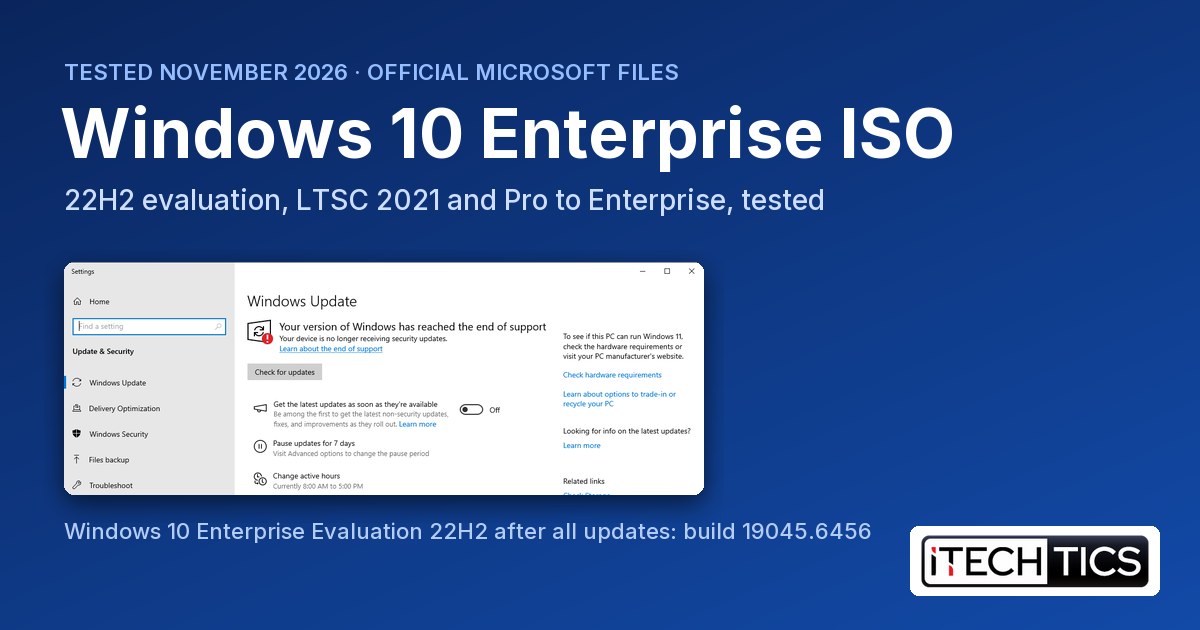


Microsoft still offers the official Windows 10 22H2 ISO for free, in 64-bit and 32-bit and in 38 languages. I downloaded it again on 25 November 2026, checked it against Microsoft’s SHA256 values, and installed it in a test PC with Secure Boot turned on. This page shows exactly how to get the file, how to make sure it is genuine, and how to keep Windows 10 safe now that free support has ended.
How I tested: I used two ISO files downloaded from Microsoft’s page, Win10_22H2_English_x64v1.iso and Win10_22H2_English_x32v1.iso. Their SHA256 values match the ones Microsoft publishes. I installed the 64-bit ISO in a Hyper-V virtual machine (Generation 2, Secure Boot and TPM on) without a product key, ran Windows Update until nothing was left, and went through Microsoft’s download page in Microsoft Edge on Windows 10. I did not test the ESU enrollment itself, Windows on Arm, or a physical USB stick.
| Windows 10 ISO | Details (checked 25 Nov 2026) |
|---|---|
| Version | 22H2, “Windows 10 2023 Update” (the last version) |
| Build inside the ISO | 19045.2965 (May 2023) |
| 64-bit file | Win10_22H2_English_x64v1.iso, 6,140,975,104 bytes (about 5.7 GB) |
| 32-bit file | Win10_22H2_English_x32v1.iso, 4,308,279,296 bytes (about 4 GB) |
| Editions in one ISO | Home, Pro, Education, Pro Education, Pro for Workstations, plus N versions and Home Single Language |
| SHA256, English 64-bit | A6F470CA6D331EB353B815C043E327A347F594F37FF525F17764738FE812852E |
| SHA256, English 32-bit | AC0B7045B6C3A72A4D46DAAB0944E109A55D9EDE3A11B775FDB57C2DD3FCA2EF |
| Support status | Ended 14 October 2025. Security updates continue through ESU until 12 October 2027 |
Open Microsoft’s Windows 10 ISO page. If you are on a Windows PC, read the next section first, because Microsoft will send you to a different page.
How to Download the Windows 10 ISO from Microsoft
Microsoft offers the same Windows 10 in three ways. Pick the one that fits what you want to do.
| Method | What you get | Best for |
|---|---|---|
| Direct ISO download | The ISO file (build 19045.2965) | Clean installs, VMs, keeping a copy, Rufus |
| Media Creation Tool | A bootable USB or an ISO (build 19045.3803) | Making a USB on a Windows PC in one go |
| Update Assistant | An in-place update of the PC you run it on | Repairing or updating Windows 10 on the same PC |
Method 1: Download the ISO directly (recommended)
When you open Microsoft’s ISO page in a browser on Windows, Microsoft redirects you to its Media Creation Tool page instead. In my test, Edge on Windows 10 landed on “Download Windows 10” with only an Update now button and a Download Now button for the tool.
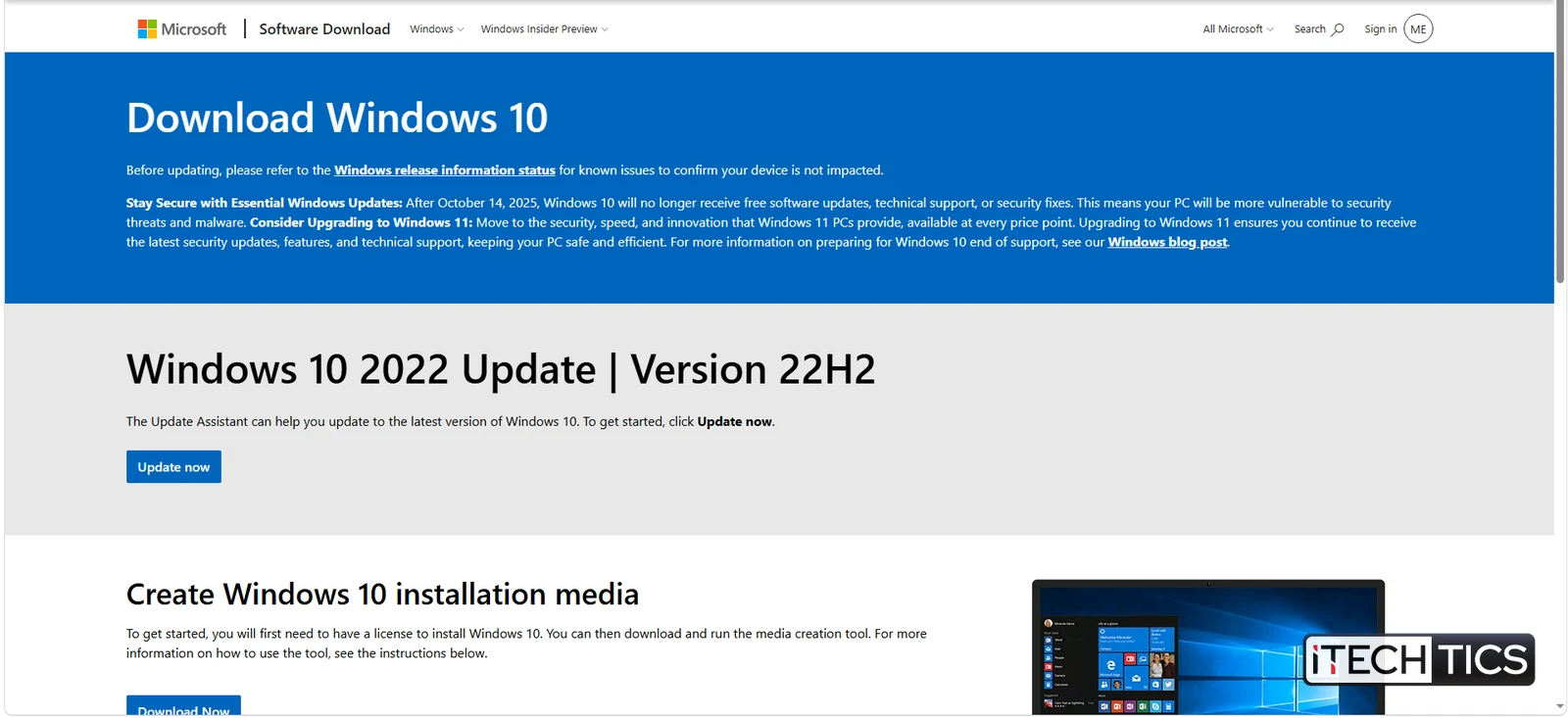
The ISO page only appears when the browser says it is running on another operating system. You can make Edge say that with one command:
- Close every Microsoft Edge window.
- Press Win + R to open the Run box.
- Paste this command and press Enter:
msedge --user-agent="Mozilla/5.0 (X11; Linux x86_64; rv:140.0) Gecko/20100101 Firefox/140.0" https://www.microsoft.com/en-us/software-download/windows10ISOEdge opens Microsoft’s real ISO page, titled “Download Windows 10 Disc Image (ISO File)”. Microsoft even explains why: you have “been routed to this page because the operating system you’re using won’t support the Windows 10 media creation tool”.
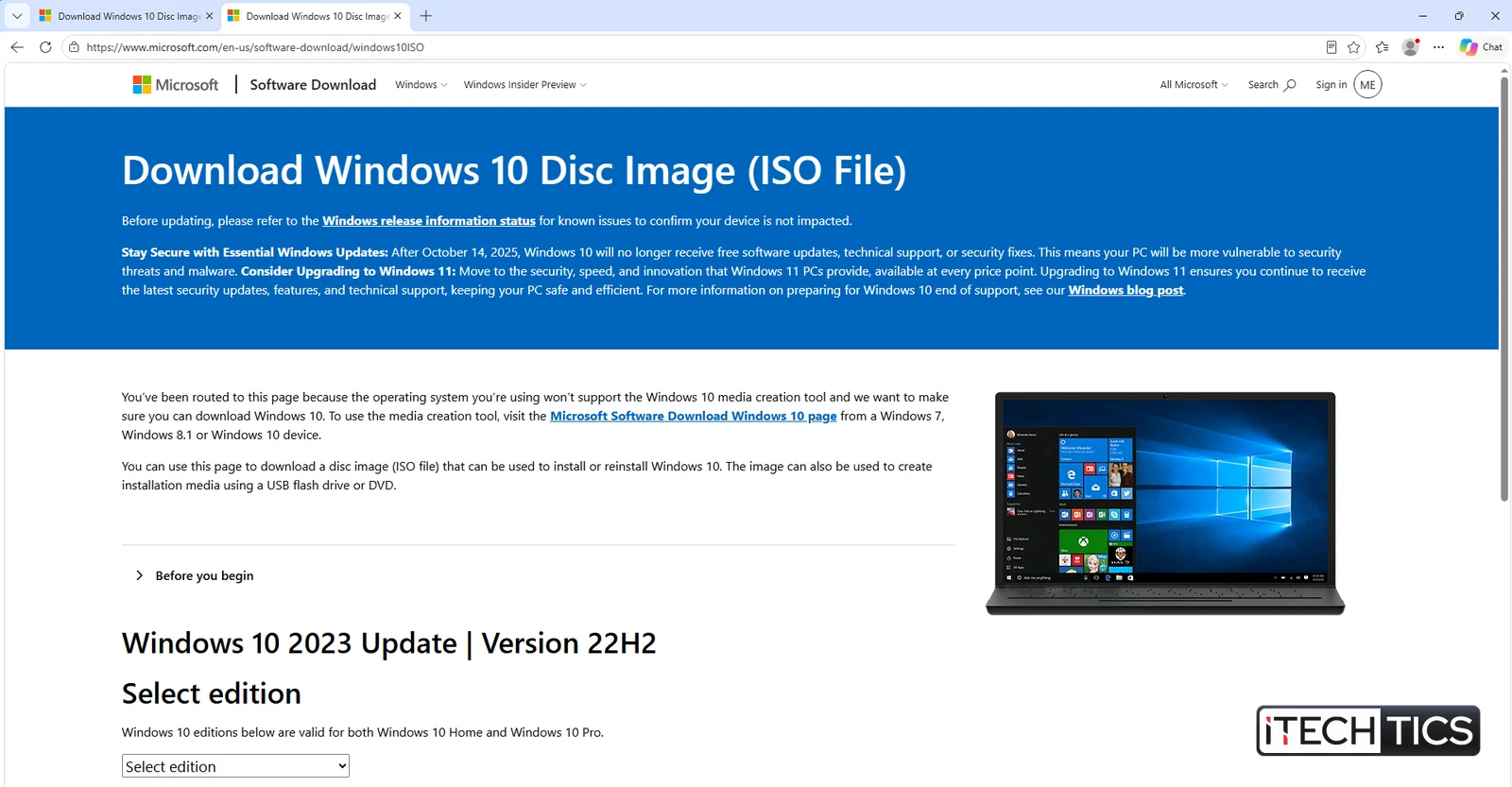
msedge --user-agent command, Edge opens the real ISO pageIf you still land on the Media Creation Tool page, Edge is probably still running in the background and ignored the setting. End all Microsoft Edge processes in Task Manager and run the command again. The setting only applies to Edge started with this command, so your normal browsing is not affected.
- Under Select edition, choose Windows 10 (multi-edition ISO) and click Confirm.
- Under Select the product language, choose your language and click Confirm. Pick the same language as your current Windows if you want to keep your files and apps.
- Click 64-bit Download (or 32-bit Download for old 32-bit PCs).
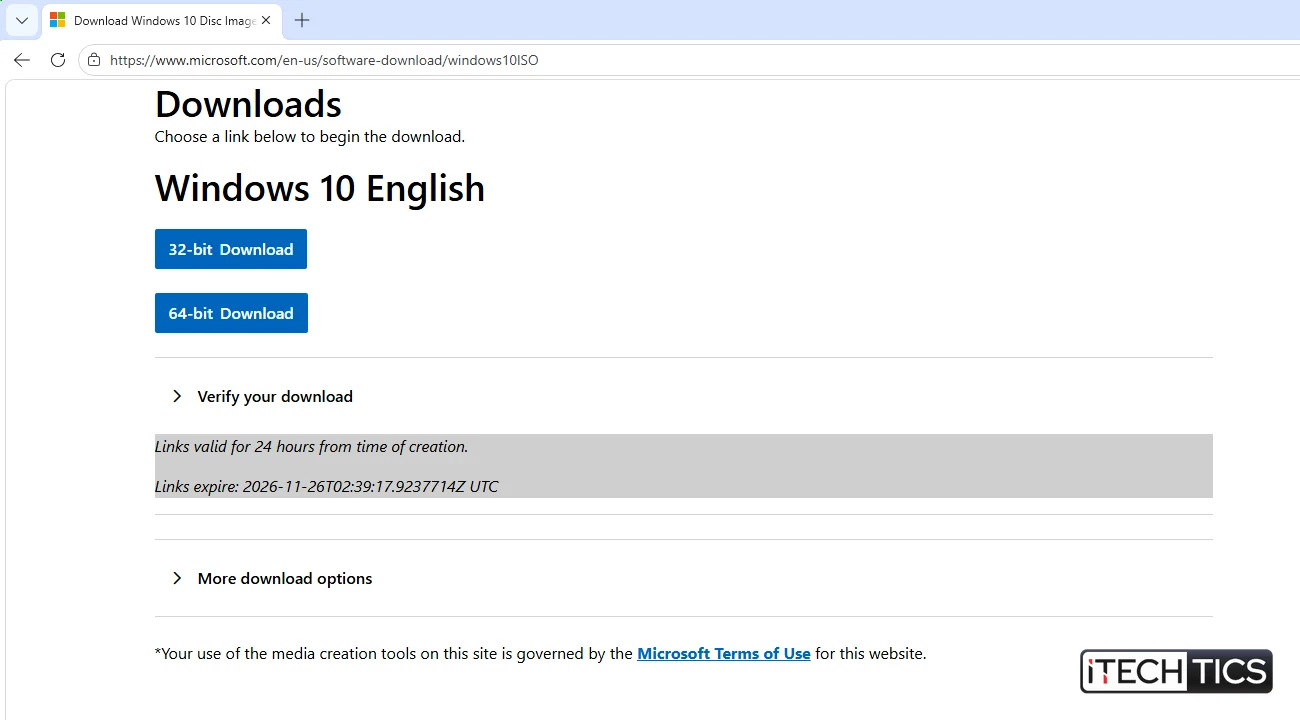
The links work for 24 hours (Microsoft shows the exact expiry time under the buttons). Start the download right away and keep the browser open. A download manager can resume a broken download within those 24 hours. After that, the link stops working and you have to create a new one by going through the steps again.
Method 2: Use the Media Creation Tool
On Microsoft’s Windows 10 download page, click Download Now under “Create Windows 10 installation media”. Run the tool, accept the license, choose Create installation media (USB flash drive, DVD, or ISO file) for another PC, pick the language, edition and architecture, and then choose USB flash drive or ISO file.
Two things I found in Microsoft’s file catalog for the tool (checked 25 Nov 2026) that most guides do not mention:
- The tool installs a newer build than the ISO. Microsoft’s catalog for the tool points to build 19045.3803 (December 2023), while the direct ISO is 19045.2965 (May 2023). Both end up on the same build after Windows Update.
- The tool’s USB stick works on FAT32. It uses a compressed install file of 3.88 GB (64-bit), which is under FAT32’s 4 GB file limit. The direct ISO’s
install.wimis 4.83 GB, which is why simply copying the ISO’s files to a FAT32 stick fails.
If the tool stops with an error such as 0x80072F8F-0x20000, check that your PC’s date and time are correct, then try again. If it keeps failing, use Method 1 instead. You don’t need the tool to get an official ISO.
Method 3: Update Assistant (same PC only)
The Update now button on Microsoft’s page downloads the Windows 10 Update Assistant. It updates the PC you run it on to the latest version of Windows 10. It does not give you an ISO or a USB stick. To repair Windows 10 while keeping your files, you can also mount the ISO (right-click > Mount) and run setup.exe from it.
How to Check That Your Windows 10 ISO Is Genuine
Microsoft publishes a SHA256 value for every Windows 10 ISO. If your file’s value matches, the file is exactly what Microsoft released. Nothing was changed, added or damaged on the way.
- Open PowerShell in the folder with the ISO (in File Explorer, type
powershellin the address bar and press Enter). - Run this command with your file’s name:
Get-FileHash .\Win10_22H2_English_x64v1.iso- Compare the Hash value with the table below. Upper or lower case does not matter.
Both of my ISO files matched Microsoft’s values exactly. If your value is different, delete the file and download it again from Microsoft. Never use an ISO with a different value, especially one from a third-party site that offers “pre-activated” Windows. Those files are modified, and you have no way of knowing what was added.
Microsoft’s SHA256 values for all 38 languages (copied from Microsoft’s page on 25 Nov 2026)
Language 64-bit SHA256 32-bit SHA256 Arabic 237FCBAA234166A836260DFA760F71F1211A6C573130C75D4CCDCA9D7D29F69A964F2D179FA13670285B8A2DB7F0CD72983E8BC5DF8554F547550486AD8AFEABBulgarian 1DFC04F3EC68602B547961A5AFD3758164E0C36A6BF420C564B1B44B375E607093C43C0F17AB17671EE16F321C0FA5E1506AAADAD0BD84A4207AD8692B78554EChinese Simplified D485D370406CBCB68959718817BD12ED87E537A14C885F84962E07136FC4A049C828ACCB08886622F5E1A127BB83070BAE0E9235EF0E31573ABC6A8A5CB55286Chinese Traditional C9594113B52F96783FB6CA8248EBBC972277E26FB215C302BFCCE50DF6C21A7962E61916A5BC6F6B7EB75D132583C4131AB81E4A19038DE527918324585720EECroatian 140462535A28CD006CD97055DABB086F8511F52BEFEECDF8BCB5ADEB64CED3AB5451422072BF6A231F2CA8CA865B89077EB2E5084DDFAFAD6B1F7949732B25B8Czech AD5EAAD75971D22C84F433854FE9671EFC360E9EB501F3B2E94A72E74C78F6FEAF1A11BEA0BA0EC789C546EE0BA0740489065CBBC0B329CC4B00B9214C23E42BDanish 74CF090D3F881F1EFCD597E01DC3FA4C6BFC2F5D3CD141CF68C92034E0BA6A57A2F4C905A75B87372BEC9DA81EDC521EBA16FA0832C269FE7F71B5DA34FE6EFFDutch 51B2F525CF7426FEFD1EF0813C4C07E7D772C61C712E20C879D8ED568D2ABCC9AC09A473E97864F6DD4E0AF4038BECF7A43FEF790F9AF9802CEF5530DFB69BCEEnglish A6F470CA6D331EB353B815C043E327A347F594F37FF525F17764738FE812852EAC0B7045B6C3A72A4D46DAAB0944E109A55D9EDE3A11B775FDB57C2DD3FCA2EFEnglish International EDC53C5C5FE6926DEA23FC3E884FBCF78CC2B9E76364BE968F806FC6D42B59D238D093AE08BF80302B900BC91A2CE5205C5086DDEEFAB29E8D529D5607B6B4DBEstonian AF649CE2920C4AFF96EF954C1B598C6DEE3E705EDC074565DDDCE3294D29F8596B59D1F6C02C5215384E5BD1D16B2591710D9F6C430F8C4C1F554973672458F1Finnish C17F3CFA9EC971DCD64B4A1152A7B563ADE165FB9DEB941F7C791E0F722D2D2F64F6427BB981BBADC0731AA686D62F157174A638EE9F2E10DF582753085B4E12French 7B7F99E804B50F5E738FFDFC571803CCDCFE139599392496048FD32C5EAEDFF9F3E3C0EF680B4C0E03A4E7601A4B00F1EA13B8EED501F16B3E0610014E788AB9French Canadian B8C09E172DBDE8E3DB14E110857AE8724D9BDB73F5B4D37D75929FF394B5CC6BE6E6A19346298D95FBC3D472AF5784755C6F510233B56FE330AD4C7AC3D2F957German D1A41A09E9AE09631A087EDF95D7F4EECAB622F88B3C824D856CFEA47FCC0B4CB0BFC1B9B176DF0303ED3A91E7332CD1A8B57B07F25752CEC9493E1333F88075Greek EE069CD752B140EFC9AF0A413313C637E13CCCB69225ED9FEDCCEB634B905EC7E7F77D3D5D81D4BF7C1EDA65ED2B163DF20265D667577C859F10765E750921F2Hebrew 15CBC5E2CFCE6987892A4466C55F079B77A6EAA862A519F701B3F686612999796E6FBC9A161BBAA41978466000F30ED363D536F86A337259E0B67A7A55539A3CHungarian DF28F3E76FA2A8D7B05531D2F1E697B877ADEFEB1311A4FCB62692D48235830BF9AC230B1F3908F1883D257EF68E450FE47FE87D59FE84B57AE0EBFBEF3BEFB9Italian 99D0376562919567F0BDDDCD43721CCA6B2834FC4EF93E0DB9F05ED26AB1A3DEDC902370B6C81CF7B48D381E1CE377187668358BE821504FDBF8FFAC3763DD09Japanese 4949E32D1B96C66C79BB8F2227624E74B5DBDA485CA0D4F8A32852F51E67AEA81570135083774BB43DB979261312803DAE5112FF94515FC6C35CAD7274518945Korean C1F5310B1DF11A1B80B6656DFB9A22A3A2D0D427E87F6BF62933C4E0C9584B4F2ECA27FE084B53E7AF674688DCCB8AC5FA4D31DD0B97F372BFEDB75D16B0EE82Latvian 6CD568D60EF842C485C38E06D9D2162977AE9A699FA0C09CEC0C0733F30E295C2CE48FF1506AFDD27F6850C91B7ABF39833D7C6F69F79690A1D6DD7F919E11B2Lithuanian AD62769CAA6C13646E0C6529042FD8C0A53A1A2E71F371079749210261166C5F3D7B3BB75C50A58D8DEAAB5E057B38DF006732ED57E5C680144B95E172313595Norwegian 3C0865B12E9B81E6D138F8CA46F91BCD810CA3583D75F3458237AF65D93D7609B49A74D5202B1B21094CE7101ABE505FA9C0F8B15605F85EC517B39B1B6175D8Polish 96AAD9E4B20B6E3F5FEA40B981263E854F6C879472369D5CE8324AAE1F6B755678E404ED9EC4BEAFE1161ADDBEC70899547483E592DE609CB6FC64DEA5A004F7Brazilian Portuguese 0CA714572FCB5B8CE480ACC3C93EAF2F34CC6507DF5F693CFF021BF4A32FAC6869E4B7ED9E5D7CEA72C075E63A493C867275608B8F9E9D1FE7D711459B32D1BEPortuguese 83F83B5A9101F5FA21DE4E925ABC7693478D84CD5FBF02CB019393048B5BDBBBF889BCE09E2117F32679D41DBD4F4CE7178A5ACC96057928A2836BBB6D7C4FB6Romanian E7D3C523D17468E83D100E5D40C9334ACB49469DB6C2685267F03AE72E2D2544E3EBB528AFDD8C946FC5AA4D19B5AAA0CAE6AECB5C6F53A45334A3999E5550FARussian 2A7C440C984EB018F513901E8ED96405213D237938C410C5089C0FAC7BA018987B339135C62CB06C8EB8748922659FC36FBE1DB08C2749B036C00676455A5D00Serbian Latin 2A23BE419AB5B2D52E2A69CC3AE39973C565363E81CAD875DD23D8A81E4AC35A55B5CB316402BA4A2EE77F3E9FCC5A256F809C79B6BEBF0310014365C3C60DF9Slovak 68CBE54D09FB3BC3C5C3BF93AB912F3225FF036D2FD2F9E0513D4189555213298950648926476B04367A08F53233664AC325CA6632BEB8DED727BA8638818D52Slovenian 5B44E6EC11915ABEF9EC63756001CEED815216A2E8D0E2A8F8F24C54FB819B20634B23B37068119A974F6E6155EC663974048A51D0A440B2E6FB8F84E4EEE8E5Spanish 0D48C6F236CA9F966ECCD84D9BE01B038516567AABF1C46DCBEE785556B19813DB414636D7EC65B1AEFCC1242D323E839823DB21FD25A2A9C5DCECC3C16C3309Spanish (Mexico) BF02C401644A4A9249EE206FAA9FD1691F4EC18BB37A9EA4FFE5C010DC147492C91F1C1EE9CCD88215CE9AD3EF4303997C78715C5A84C8A4D8C9F67D307A3633Swedish 72A5EB42D5824FEE11B1708AED2526B2C3A73A6EC5E0D9C7CDD9552CB3C25BCA9B1788454A42E1CA2196E2633DCD7C0BD3F94A9F8D29C60EB064CFA8A966EBD3Thai D823AA445C4B575775918301948A44B7666FC1044CC9BB53B2EE981E9A01FD1584D93E48EA10AB2D766F17DA242379146F8395BDCA7F860755B27AF7DBD0F6C3Turkish F66AD547FB42F9D37DC8E86214E1E326E515AA20843F734C7F8F947E967BEE5357B51F3F9F36DD2A1586745751218D16ABACD8703A60FF9368C32CCA3CF0C5E9Ukrainian 2AE3B2DCCF609DC3C149FF344AB73B4E8E0B12BF7C97489B64DFC7A162A7C7D9CEF1AAA637AC8F0E563244DEA7EFBDCF6C85288B131943DABD108182D9B0656C
Which Edition Should You Install?
One Windows 10 ISO contains 11 editions. When I installed it, Setup listed all of them, each dated 5/5/2023:
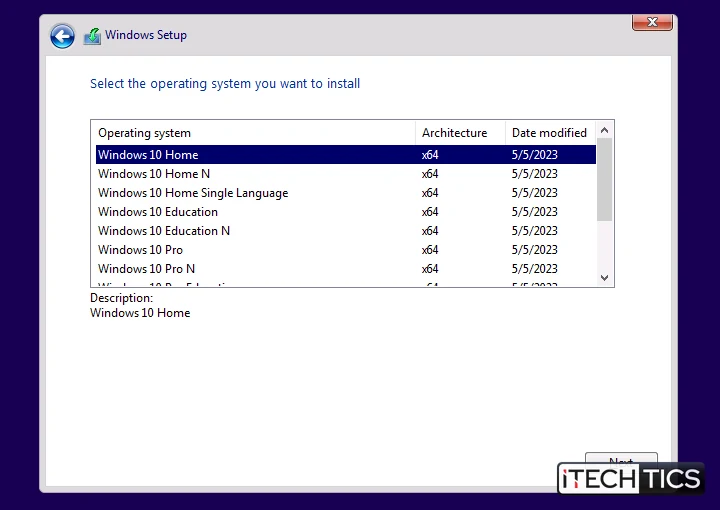
- Home and Pro: what most PCs came with. Install the same edition your PC had, so that it activates by itself.
- Home Single Language: preinstalled on many budget laptops. If your laptop came with it, choose it again, or Windows will not activate.
- Education and Pro Education: for schools with education licenses.
- Pro for Workstations: for high-end PCs with a matching license.
- N editions (Home N, Pro N and others): the same as the normal editions but without the media apps. They are sold mainly in Europe. Choose N only if your license is for an N edition.
Not in the ISO: Windows 10 Enterprise and LTSC. Microsoft gives those to businesses through volume licensing, not through this page.
64-bit or 32-bit? Choose 64-bit for almost every PC made in the last 15 years. The 32-bit ISO is only for old PCs with a 32-bit processor or very little memory. A 32-bit Windows can only use about 4 GB of RAM.
Older versions? Microsoft only offers 22H2, the final version of Windows 10. See older Windows 10 versions below for 21H2, 20H2, 1909 and the others.
Older Windows 10 Versions (1909, 2004, 20H2, 21H1, 21H2)
Microsoft only offers Windows 10 22H2. The earlier versions are no longer on Microsoft’s download pages, and none of them gets security updates any more:
| Version | Build | Released | Support for Home and Pro ended |
|---|---|---|---|
| 21H2 | 19044 | 16 November 2021 | 13 June 2023 |
| 21H1 | 19043 | 18 May 2021 | 13 December 2022 |
| 20H2 | 19042 | 20 October 2020 | 10 May 2022 |
| 2004 | 19041 | 27 May 2020 | 14 December 2021 |
| 1909 | 18363 | 12 November 2019 | 11 May 2021 |
Versions 2004, 20H2, 21H1, 21H2 and 22H2 share the same core: build 19041 plus a small “enablement package” that switches on the newer version. Apps and drivers made for 20H2 or 21H2 run on 22H2. If an app or guide asks for one of these versions, install 22H2 instead. It is the only version Microsoft still offers and the only one that can still get security updates (through ESU).
We don’t link to copies of older ISOs on third-party sites. You can’t be sure such a file is unmodified, and an old version would run without any security updates.
The table below shows every Windows 10 version, including the LTSC editions, with its support dates. It updates when Microsoft changes a date.
Showing 34 of 34 versions · statuses as of 28 Nov 2026Windows 10 versions and support dates
Version Mainstream support Security updates ESU (paid extended) Status Windows 10 22H2Enterprise and EducationCommercial ESU through volume licensing: US$61 per device for year one, price doubles each year, maximum three years. Year 1 ends 13 Oct 2026, year 2 on 12 Oct 2027, year 3 on 10 Oct 2028. Free for Windows 10 VMs in Windows 365, Azure Virtual Desktop and Azure. — 14 Oct 2025 10 Oct 2028 Extended support only1 yr 10 mo left (extended) Windows 10 22H2Home and ProConsumer ESU for Home, Pro, Pro Education and Pro for Workstations on 22H2: free if you sync PC settings with Windows Backup, or 1,000 Microsoft Rewards points, or a one-time US$30. Microsoft extended it in June 2026; it now runs to 12 October 2027. Businesses (including Pro in commercial use) can buy commercial ESU instead, up to 10 October 2028. — 14 Oct 2025 12 Oct 2027 Extended support only10 mo left (extended) Windows 10 IoT Enterprise LTSC 2021 12 Jan 2027 13 Jan 2032 — Supported5 yr 1 mo left Windows 10 Enterprise LTSC 2021 12 Jan 2027 12 Jan 2027 — Ending within a year1 mo left Windows 10 21H2Enterprise and Education — 11 Jun 2024 — Unsupported Windows 10 21H2Home and Pro — 13 Jun 2023 — Unsupported Windows 10 21H1Home and Pro — 13 Dec 2022 — Unsupported Windows 10 21H1Enterprise and Education — 13 Dec 2022 — Unsupported Windows 10 20H2Enterprise and Education — 9 May 2023 — Unsupported Windows 10 20H2Home and Pro — 10 May 2022 — Unsupported Windows 10 2004Enterprise and Education — 14 Dec 2021 — Unsupported Windows 10 2004Home and Pro — 14 Dec 2021 — Unsupported Windows 10 1909Enterprise and Education — 10 May 2022 — Unsupported Windows 10 1909Home and Pro — 11 May 2021 — Unsupported Windows 10 1903Enterprise and Education — 8 Dec 2020 — Unsupported Windows 10 1903Home and Pro — 8 Dec 2020 — Unsupported Windows 10 IoT Enterprise LTSC 2019 9 Jan 2024 9 Jan 2029 — Security fixes only2 yr 1 mo left Windows 10 Enterprise LTSC 2019 9 Jan 2024 9 Jan 2029 — Security fixes only2 yr 1 mo left Windows 10 1809Enterprise and Education — 11 May 2021 — Unsupported Windows 10 1809Home and Pro — 10 Nov 2020 — Unsupported Windows 10 1803Enterprise and Education — 11 May 2021 — Unsupported Windows 10 1803Home and Pro — 12 Nov 2019 — Unsupported Windows 10 1709Enterprise and Education — 13 Oct 2020 — Unsupported Windows 10 1709Home and Pro — 9 Apr 2019 — Unsupported Windows 10 1703Enterprise and Education — 8 Oct 2019 — Unsupported Windows 10 1703Home and Pro — 9 Oct 2018 — Unsupported Windows 10 1607 LTS 12 Oct 2021 13 Oct 2026 — Unsupported Windows 10 1607Enterprise and Education — 9 Apr 2019 — Unsupported Windows 10 1607Home and Pro — 10 Apr 2018 — Unsupported Windows 10 1511Enterprise and Education — 10 Oct 2017 — Unsupported Windows 10 1511Home and Pro — 10 Oct 2017 — Unsupported Windows 10 1507 LTS 13 Oct 2020 14 Oct 2025 — Unsupported Windows 10 1507Enterprise and Education — 9 May 2017 — Unsupported Windows 10 1507Home and Pro — 9 May 2017 — Unsupported Support timeline
How to Make a Bootable Windows 10 USB
You need a USB stick of at least 8 GB. Everything on it will be deleted.
- Easiest: the Media Creation Tool (Method 2 above) makes the USB stick for you and works on FAT32.
- From the ISO: use Rufus. Select the stick and the ISO, then choose GPT for newer PCs that boot in UEFI mode, or MBR for older PCs with a legacy BIOS. Because the 64-bit
install.wimis larger than 4 GB, Rufus formats the stick as NTFS and adds a small boot partition so that UEFI PCs can still start from it. This is described in Rufus’s FAQ. - Several ISOs on one stick: Ventoy lets you copy the ISO file onto the stick and boot it from a menu.
If the PC won’t start from the stick, open the boot menu (often F12, F11, Esc or F8 when the PC starts), make sure you pick the UEFI entry for the USB stick, and try another USB port. On a PC that uses UEFI, the stick must be prepared with GPT.
How to Install Windows 10 Step by Step
- Start the PC from the USB stick or DVD.
- Choose your language and keyboard, click Next, then Install now.
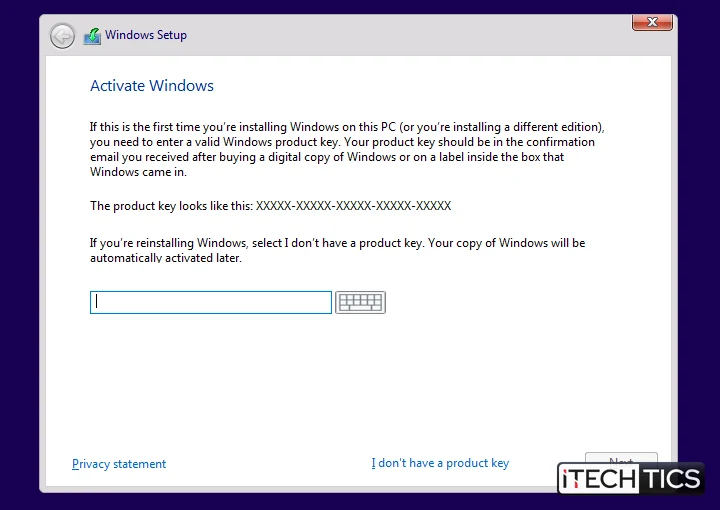
- On the Activate Windows screen, click I don’t have a product key if you are reinstalling on a PC that already had Windows 10 or Windows 11. It will activate by itself later. Enter a key only if you bought one.
- Choose the edition your license is for (see above) and click Next.
- Accept the license terms.
- Choose Custom: Install Windows only (advanced) for a clean install. Upgrade only works when you start Setup from a running Windows.
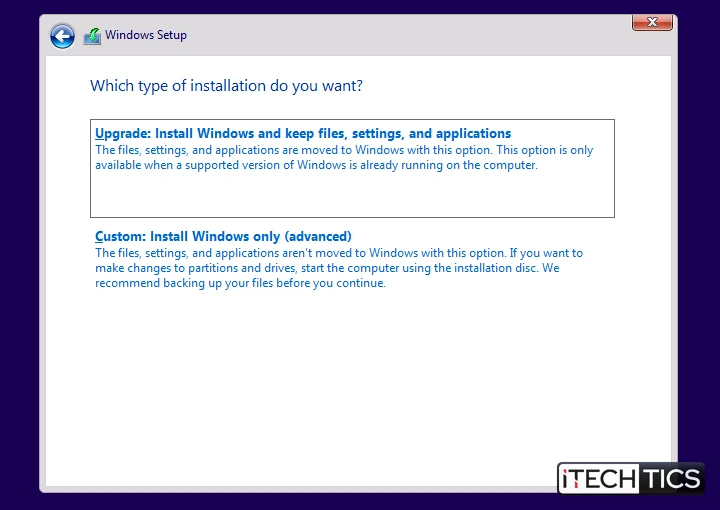
- Select the drive and click Next. To start clean, delete the old Windows partitions first. This erases everything on them, so back up your files.
- Windows copies its files and restarts a few times. Then answer the setup questions and create your account.
In my test PC, copying the files took less than 3 minutes. Reaching the desktop took about 25 minutes in total.
Activation and Product Keys
The ISO is free. Using Windows 10 needs a license.
- Reinstalling on the same PC: if this PC ran an activated Windows 10 or Windows 11 before, it has a digital license. Skip the product key during Setup, install the same edition, and Windows activates itself when it goes online. Sign in with the Microsoft account linked to the license if it does not.
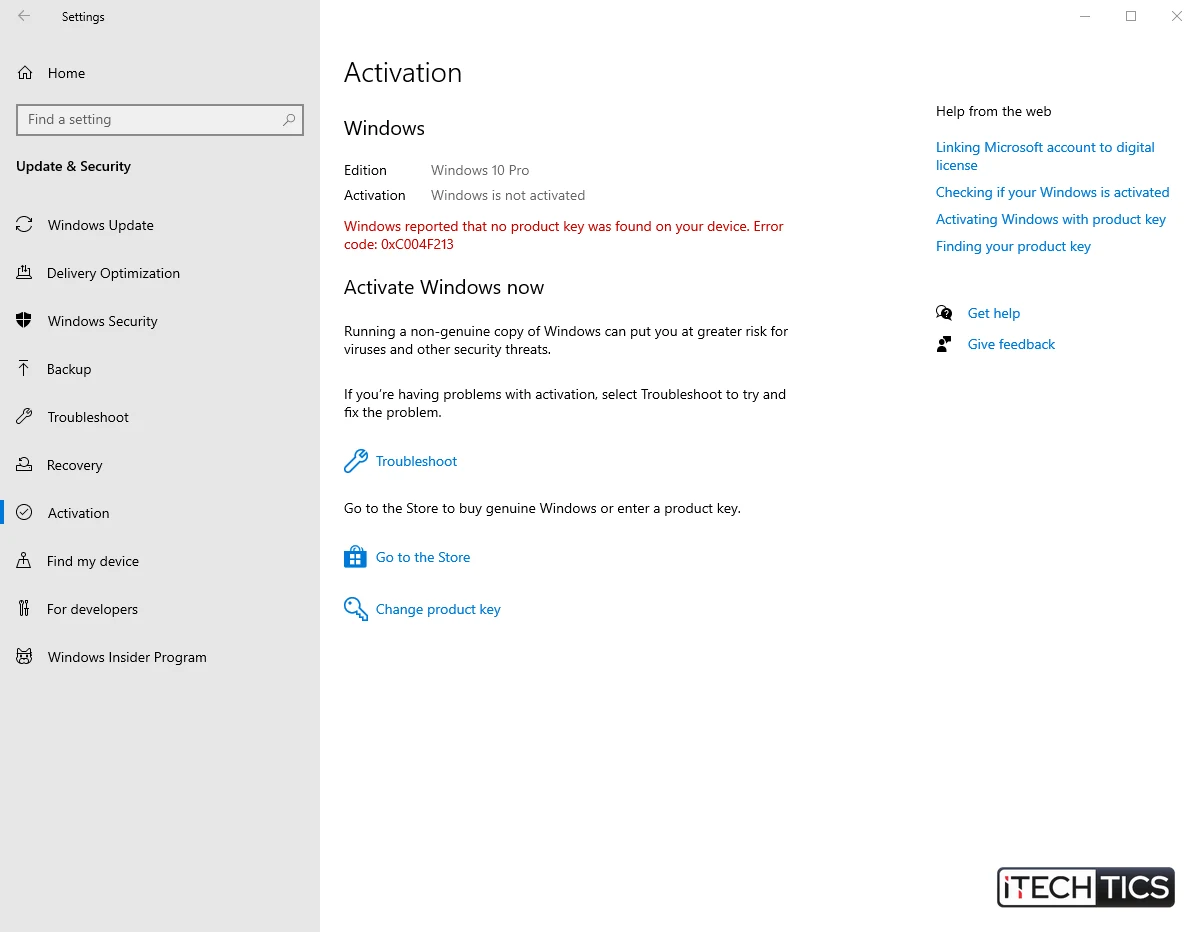
- New PC, new hard drive or a virtual machine: you need a product key. Without one, Windows works but shows a watermark and limits personalization. On my test PC, the Activation page showed “Windows is not activated. Windows reported that no product key was found on your device. Error code: 0xC004F213”:
- Where to get a key: buy Windows from Microsoft or a trusted retailer, or use the key from your PC’s label or the box. See Windows product key types for the differences between Retail, OEM and volume keys.
Please don’t use “free keys” from comments, videos or key generator sites, or “activators”. Shared keys get blocked, and activator tools are a common way to get malware. To check your status afterwards, see how to check if Windows 10 is activated.
How to Keep Windows 10 Safe After End of Support
Microsoft ended free support for Windows 10 on 14 October 2025. A new install from the ISO still works, but it needs two steps to be safe.
Step 1: Install all available updates
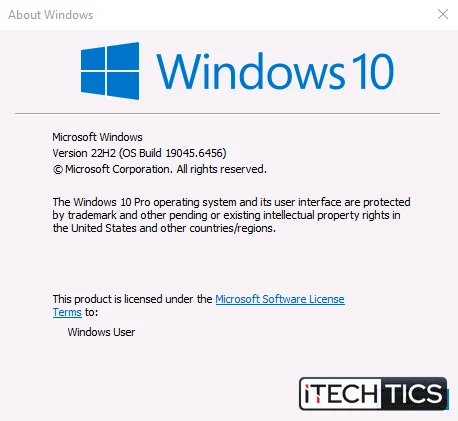
The ISO contains build 19045.2965 from May 2023. After the first sign-in, Windows Update said “No updates available” until I clicked Check for updates. Then it took:
| What happened | Result in my test |
|---|---|
| First round | 8 updates in 38 minutes, including the October 2025 cumulative update (KB5066791) and .NET Framework 4.8.1, then a restart |
| Second round | 4 updates in 6 minutes, including KB5126256 (the ESU licensing preparation package), then a restart |
| Third round | No more updates |
| Final build | 19045.6456 (October 2025) |
| Total | About 51 minutes, 12 updates, 2 restarts |
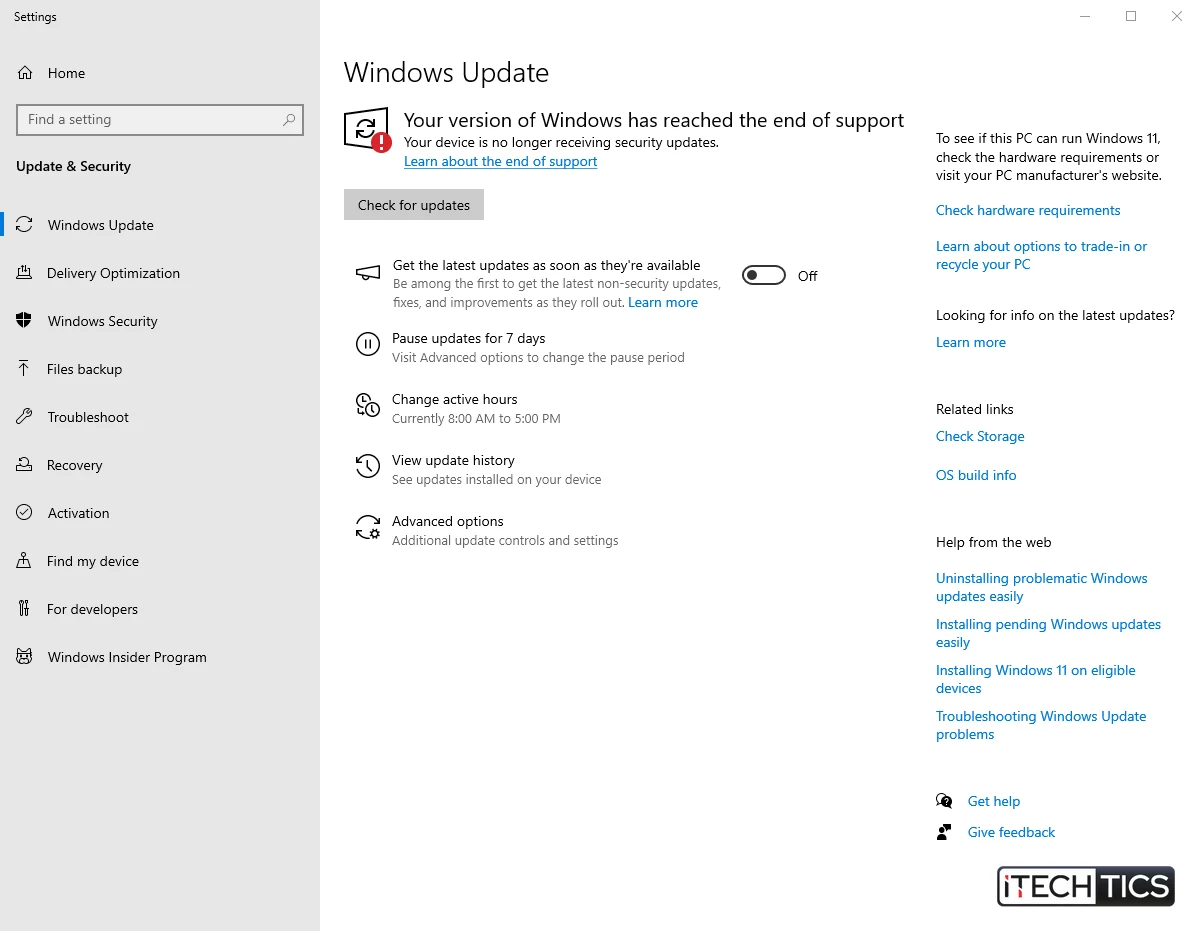
Without ESU, that is where updates stop. Windows Update then shows “Your version of Windows has reached the end of support. Your device is no longer receiving security updates.”
You can check whether a PC is on the newest build with our Windows build checker.
Which Windows 10 version am I running?
Run one of these commands, then paste the build number below.
Step 2: Enroll in Extended Security Updates (ESU)
The consumer ESU program gives home users security updates until 12 October 2027. According to Microsoft, you can join in one of three ways:
- Free, if you sync your PC settings (Windows Backup).
- 1,000 Microsoft Rewards points.
- A one-time payment of $30 (or the local equivalent).
One ESU license covers up to 10 PCs. To enroll, go to Settings > Update & Security > Windows Update and select Enroll now. Microsoft’s requirements are:
- Windows 10 version 22H2 Home, Pro, Pro Education or Pro for Workstations.
- The latest updates and KB5126256 installed (Step 1 above does both).
- A Microsoft account with administrator rights (not a child account). If you use a local account, Windows asks you to sign in.
- Not offered for kiosk PCs, or PCs joined to a domain or managed by an organization.
Enrolling late is fine: after enrollment, the PC receives all the security updates released since October 2025. I did not test the enrollment itself. In my test PC, which was not activated, the Enroll now link did not appear even with all updates installed. Microsoft’s list does not mention activation, but it is worth activating Windows first if you don’t see the link. Use our ESU cost calculator to compare the options for several PCs.
For businesses: commercial ESU costs $61 per device for the first year and doubles each year, for up to three years. It is free for Windows 10 running in Windows 365, Azure Virtual Desktop and Azure virtual machines (Microsoft Learn). Windows 10 Enterprise LTSC 2021 is supported until 12 January 2027, with paid ESU until 8 January 2030. Windows 10 IoT Enterprise LTSC 2021 is supported until 13 January 2032, but it is sold only with devices (Microsoft lifecycle). All dates are on our Windows 10 end-of-life page.
Use the ISO in a Virtual Machine
The ISO works in any virtual machine app. I used Hyper-V:
- Hyper-V: create a Generation 2 VM, keep Secure Boot on with the Microsoft Windows template, give it at least 4 GB of memory and a 64 GB disk, and attach the ISO as a DVD drive. Press a key when the VM shows “Press any key to boot from CD or DVD”. Hyper-V is included in Windows 10 Pro; see how to enable Hyper-V.
- VirtualBox and VMware Workstation: create a new VM, select the ISO, and choose Windows 10 (64-bit) as the guest type. Both apps set the right options for you.
Windows in a VM needs its own license to be activated, just like a physical PC.
Frequently Asked Questions
Is the Windows 10 ISO free?
Yes. Downloading the ISO from Microsoft is free and legal. You need a valid license to activate Windows after installing it.
Can I still download Windows 10 in 2026?
Yes. On 25 November 2026, Microsoft’s ISO page offered Windows 10 22H2 in 64-bit and 32-bit, and the downloads worked.
Why does Microsoft give me the Media Creation Tool instead of the ISO?
Microsoft shows the tool to browsers running on Windows. Open the page with the Edge command in Method 1, and you get the ISO links instead.
My download stopped. Can I resume it?
Within 24 hours, yes: Microsoft’s links stay valid for 24 hours, and a download manager can resume them. After that, go through the page again to get new links.
Does the ISO include Windows 10 Pro?
Yes. The “multi-edition ISO” includes Home, Pro, Education, Pro for Workstations and their N versions. You choose the edition during Setup.
Is 22H2 the latest version of Windows 10?
Yes. 22H2 is the final version. Microsoft will not release another one. Updates come only as monthly patches (and only through ESU after October 2025).
Does a fresh install of Windows 10 still get security updates?
It gets all updates up to October 2025 through Windows Update. Newer security updates need ESU, which runs until 12 October 2027.
Can I go back from Windows 11 to Windows 10?
Within 10 days of upgrading, use Settings > System > Recovery > Go back. After that, back up your files and do a clean install with this ISO. Your PC’s digital license works for Windows 10 too.